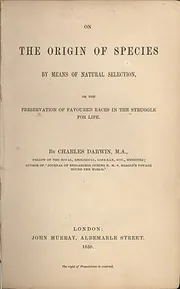
On the Origin of Species, published by Charles Darwin in 1859, is a revolutionary scientific work that transformed humanity's understanding of life. Darwin presents his theory of evolution by natural selection, arguing that all species descend from common ancestors and gradually change over vast stretches of time. Organisms better adapted to their environments survive and reproduce, passing advantageous traits to their offspring. Drawing on evidence from geology, embryology, and his famous voyage to the Galápagos Islands, Darwin challenged traditional views of creation with compelling logic and meticulous observation. Though it sparked intense controversy, the book laid the foundation of modern biology and reshaped science, philosophy, and society forever.